|
|
Honda CB750/900/1100F SuperSport Website: SuperSport Forums |
|
|
|
|
| Author |
Message |
urhere
Silver CB750F


Joined: Jan 18, 2004
Posts: 599
Location: Upstate NY

|
 Posted:
Mon Dec 06, 2004 3:19 pm Posted:
Mon Dec 06, 2004 3:19 pm |
 
|
Quick--I need another distraction to keep me from grading papers and doing our grad program's assessment...aaaaaaagggghhhhhh.....
About every other day I see a posting on the ebay forum for a mikuni or keihin carb and there's sometimes a question about whether the listing shows a sidedraft or downdraft version. Now sidedrafts are for our bikes, right? And they're called sidedraft because the air and fuel flow in horizontally into the manifolds? So do downdraft carbs sit above the head? Seems like it would be harder to deliver the fuel along any but a straight line path. And now the main question--what do you look for in one of the ebay photos to tell you that the carbs are sidedraft? Are the venturis tipped slightly with respect to horizontal?
Jim |
| |
|

 
|
|
TigreST
Red CB1100F


Joined: Jul 16, 2003
Posts: 4283
Location: Sarnia, Ontario, Canada
|
| Posted:
Mon Dec 06, 2004 4:10 pm |
|
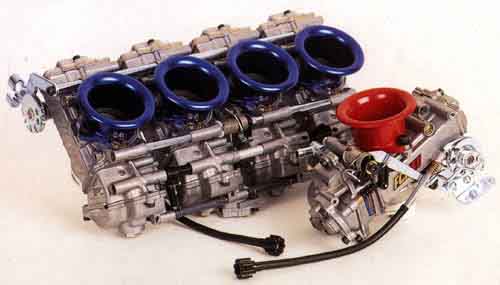
The float bowl config of the down-draft carbs are set at an angle to allow for the floats to function in a normal manner. At least this is how the FCR's are set up. The down-draft float bowls are wedge shaped. If this hotlink works you may notice the diff in the following picture. The blue velocity stacks are on the down-draft FCR's. Notice the angle between the face of the velocity stack realitive to the float bowls. The red veloctiy stack carb is a side-draft version with the float bowl angle at near 90degree's to the intake path. E-bay photo's do not show this detail in many cases,..that's why it's best to ask for more info or better pic's.
Tony
 |
| |
|
|
|
|
SixSRacing
Hawk


Joined: Sep 18, 2003
Posts: 317
Location: Bangor, ME.
|
| Posted:
Mon Dec 06, 2004 4:20 pm |
|
Carbs. are application specific, so it's difficult to pin down to perfection, here is a general description.
Side draft carbs: Air flow will be parallel with float level.
Down draft carbs: Air flow will be perpendicular to float level.
There is another alternative, up draft carbs. mostly used on older farm equipment, some ancient airplanes and I have seen at least one high performance turbo application in a boat.
There are exceptions to these guidelines due to specific applications as noted above. But this should give you the basics. |
| |
|
|
|
|
sonicrete
Red CB1100F
Joined: Aug 19, 2003
Posts: 15472
Location: Lancaster,Ohio
|
| Posted:
Mon Dec 06, 2004 5:31 pm |
|
Main difference is inside the float bowl.
On a "normal" side draft,the main jet is "in line" with the jet needle.
The downdraft are drilled at an angle so the main jet is submerged evenly not at the extreme rear where it would be if a regular carb was mounted "at an angle". If you put downdraft carbs in a side draft arrangement,the main jet would become exposed,ie out of the fuel,under acceleration. |
| |
|
|
|
|
urhere
Silver CB750F
Joined: Jan 18, 2004
Posts: 599
Location: Upstate NY
|
| Posted:
Mon Dec 06, 2004 6:22 pm |
|
Ah, thanks guys. Tony--the link you included came out as an X on my browser. Could you point me to the source?
Jim |
| |
|
|
|
|
TigreST
Red CB1100F
Joined: Jul 16, 2003
Posts: 4283
Location: Sarnia, Ontario, Canada
|
| Posted:
Mon Dec 06, 2004 8:08 pm |
|
|
|
|
|
urhere
Silver CB750F
Joined: Jan 18, 2004
Posts: 599
Location: Upstate NY
|
| Posted:
Mon Dec 06, 2004 8:15 pm |
|
|
|
|
|
Matt at PSB
Rest in Peace

Joined: Feb 07, 2004
Posts: 2924
Location: Missoula, MT., USA.
|
| Posted:
Mon Dec 06, 2004 8:42 pm |
|
The engineering thinking for down draft carbs. In a horizontal (sided draft) carb the fuel/air charge has to make an 80 to 90 degree downward turn to pass from the inlet port through the valves & into the combustion chamber.
Downdraft carbs used in motorcycles are really more like 45 degrees from horizontal not 90 degrees as would be a true downdraft carb. This is combined with the engineering of leaning the cylinders/cylinder head forward toward the steering head as was first done in a large way with the 1988 Yamaha FZR1000. These two engineering tricks combine to move the C of G closer to the front wheel's axle and allow the intake fuel
/air charge a much straighter shot at the valves & combustion chambers. It turns out that making the fuel/air inlet charge turn corners slows it down in velocity and dis-entrains the atomized fuel droplets. This is not good.
An excellent example of what removing sharp corners in the inlet (and exhaust) charges paths can do for performance can be seen in the once ubiquitous inline OHV six cylinder engines that were, until very recently, produced by nearly every car/ truck manufacturer. These were built with long cast iron intake & exhaust manifolds riddled with compound 90-degree turns. As OEM built these engines were reliable, gutless, & not fuel-efficient. Take any of these engines (Chevy/Toyota 235 cu. in., Ford 300, Chevy 250, Chrysler 225) and ditch the stock manifolds and equip them with straight shot smooth flowing aftermarket manifolds/ headers & you end up with a small powerhouse that will run with or beyond it's small displacement V8 brethren, last a lot longer than the V8s & get better gas mileage.
Most manufactures made the decision to discontinue these inline OHV sixes rather than rework the manifolds. The long narrow shape of the inline six did not help either. These tricks were not lost to the OEM manufactures. Most of these sixes were designed in the late 1920s to early 1950s period. Not a time of advanced flow dynamics modeling in auto engine manifold design. Exceptions include the Chrysler 225 (slant six) and some of the GM OHC sixes. All of these dated from the 1960s and as such had considerable improved manifold flow. The GM OHC sixes went on to become a great performance engine package in the Australian GMs (Holdens). The most valuable Pontiac Firebird you can own/restore is the 1967, OHC inline six, four speed. Unfortunately in the USA bigger is always better even if it is not. Hence the late sixties are famous for V8 muscle cars not high performance sixes. When Chrysler purchased Jeep in late 1987 they inherited a 253 cu. in. (4 Liter) inline OHV six. Chrysler went ahead & retro fitted this engine with modern MPSEFI ( multiport sequential electronic fuel injection), long straight shot intake port runners, and a factory tuned tubular steel exhaust header. This revolutionized & saved this engine that dated from the 1950s. So much so that it is the last domestic inline OHV six still in production and it comes in new Jeeps still. In fact it is currently THE engine to get in a Jeep that you plan on off roading in. Sure, I love Hemis too, but the 4 liter six is better off road.
All this is due to the wonders of straighter intake port runners.
Matt at PSB |
| |
|
|
|
|
urhere
Silver CB750F
Joined: Jan 18, 2004
Posts: 599
Location: Upstate NY
|
| Posted:
Tue Dec 07, 2004 1:01 pm |
|
Now if I only had $669... |
| |
|
|
|
|
Da_Hose
CB1100F

Joined: Mar 28, 2004
Posts: 3146
Location: Napa, Ca.
|
| Posted:
Wed Dec 08, 2004 2:47 am |
|
Incidentally the 6 cylinder engine is the smoothest running engine around due to the counterbalancing from the 6 cylinder firing order and assembly. Notice how 4's and 8's have a sharp bark and loping idle when tuned to high heaven, but super 6's and 12's have this smooth mechanical growl? I personally love in-line 6's. They sound awesome and produce godawful amounts of streetable and smooth power.
Jose |
| |
|
|
|
|
|
|
|
View next topic
View previous topic
You cannot post new topics in this forum
You cannot reply to topics in this forum
You cannot edit your posts in this forum
You cannot delete your posts in this forum
You cannot vote in polls in this forum
You cannot attach files in this forum
You cannot download files in this forum
|
Powered by phpBB © 2001-2008 phpBB Group
:: Theme & Graphics by Daz :: Ported for PHP-Nuke by nukemods.com ::
All times are GMT |
|
|
|
|
|

 ::
::  ::
::  ::
::

